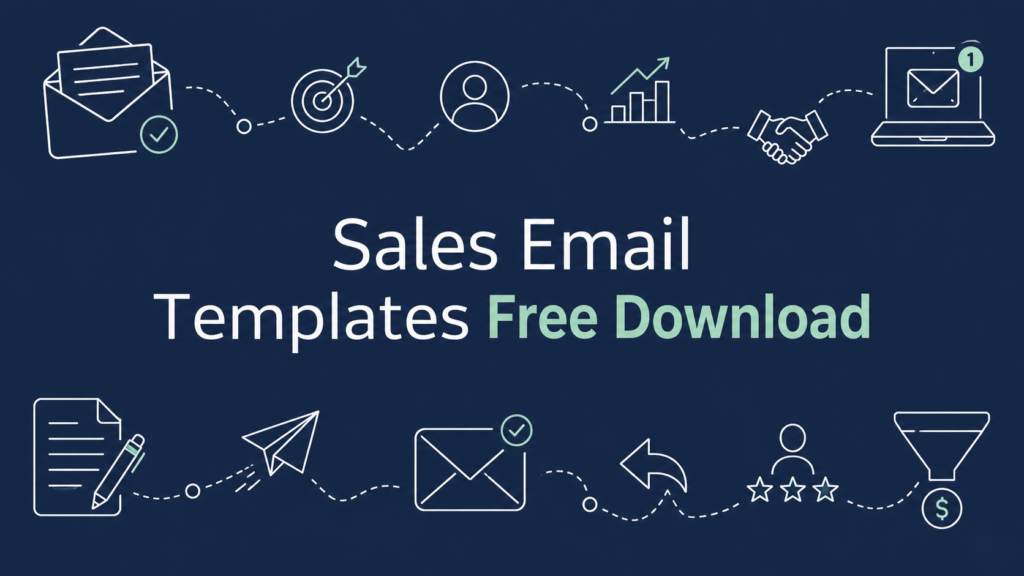
A lot of sales emails fail before the recipient reads the first sentence. They fail in the inbox.
Buried between meeting invites, internal updates, shipping notifications, newsletters, and whatever else arrived during the previous fifteen minutes. That's the reality facing every salesperson who hits "send." Whether you're following up after a customer visit or reaching out to a new prospect, having the right tools alongside proven email templates can make the entire sales process more consistent.
Which is why having a collection of proven email templates can save an enormous amount of time. Not because templates magically create replies. They don't. People can spot a lazy copy-and-paste email from a mile away.
What templates do provide is a starting point. A framework. Something that keeps you from staring at a blank screen wondering how to begin. The strongest Sales emails still sound like they came from a real person. They feel specific. Relevant. Human. The strongest sales emails are usually the simplest ones. Clear, concise writing is far more likely to hold a prospect's attention than paragraphs packed with unnecessary detail, a principle echoed by Harvard Business Review.
The examples below are designed with that in mind.
Subject: Quick question about [Company Name]
Hi [First Name],
I came across your company while researching businesses in the [industry] space and noticed you're involved with [specific detail].
I'm reaching out because we work with companies facing similar challenges around [problem].
Not sure if this is something you're currently evaluating, but I thought it might be worth introducing myself.
Would it make sense to have a quick conversation sometime next week?
Thanks,
[Your Name]
This type of email works because it doesn't try too hard.
No lengthy introduction. No exaggerated claims. Just a straightforward message that respects the reader's time.
Subject: Following up
Hi [First Name],
Wanted to circle back on my previous email.
I know inboxes get crowded. Mine certainly does.
If improving [specific area] is on your radar this year, I'd be happy to share a few ideas that have worked for similar companies.
If now isn't the right time, no worries.
Hope your week is going well.
Best,
[Your Name]
A surprising number of opportunities come from follow-ups.
Not because prospects ignored the first email intentionally.
People get busy.
Things slip through the cracks.
Sometimes that's the entire explanation.
Subject: Great meeting you
Hi [First Name],
Enjoyed meeting you at [event name].
I appreciated our conversation about [specific topic discussed].
You mentioned that your team has been working through [challenge or initiative], and I kept thinking about that discussion afterward.
I'd be happy to continue the conversation if you'd find it useful.
Either way, it was great connecting.
Best,
[Your Name]
This one feels more natural when you reference something specific.
Even a small detail can make a difference.
People notice.
Subject: [Referral Name] suggested I reach out
Hi [First Name],
[Referral Name] mentioned that it might be worthwhile for us to connect.
They thought there could be some overlap between what your team is working on and the work we do with organizations facing similar situations.
Rather than filling your inbox with a long explanation, I figured I'd introduce myself and see if you'd be open to a brief conversation.
Let me know what makes sense.
Thanks,
[Your Name]
Referrals create instant familiarity.
That's valuable.
The key is using the referral naturally instead of treating it like a sales weapon.
Subject: Checking back in
Hi [First Name],
We spoke a while back about [topic].
At the time, it sounded like your team had several priorities competing for attention, which is completely understandable.
I wanted to check in and see whether anything has changed since then.
If this isn't currently a focus, no need to respond.
If circumstances have shifted, I'd be happy to reconnect.
Best,
[Your Name]
Old opportunities often become new opportunities.
Timing changes.
Budgets change.
Leadership changes.
Things happen.
Subject: Thought this might be useful
Hi [First Name],
I recently came across an article, report, or case study related to [topic] and thought of your team.
No sales pitch attached.
Just figured it might be relevant given what you're working on.
Hope it's helpful.
Best,
[Your Name]
Not every email needs to ask for a meeting.
Sometimes providing something genuinely useful creates more goodwill than another request for calendar time.
Funny how that works.
Subject: Questions after our conversation
Hi [First Name],
Thanks again for taking the time to meet earlier.
I enjoyed learning more about your team's goals and current priorities.
I've attached the information we discussed, along with answers to the questions that came up during our conversation.
If additional questions surface, feel free to reach out.
Happy to help however I can.
Best,
[Your Name]
This email serves as a bridge.
The meeting ends. The sales process continues.
A thoughtful follow-up helps maintain momentum without feeling pushy.
Subject: Should I close the file?
Hi [First Name],
I've reached out a few times and haven't heard back, so I wanted to check in one last time.
It's entirely possible this isn't a priority right now.
If that's the case, no problem at all.
I'll step back unless I hear otherwise.
If you'd still like to connect at some point, feel free to reach out whenever the timing makes sense.
Thanks,
[Your Name]
Oddly enough, these emails sometimes generate responses.
People appreciate directness.
And occasionally they were interested all along but simply got distracted.
Templates aren't shortcuts to instant Sales success. If they were, every salesperson would have a packed calendar and a full pipeline. The real value comes from reducing the time spent reinventing the wheel every morning.
Start with a template. Adjust the language. Add context. Reference something specific about the person receiving it. Make it sound like something you'd actually say. Because that's the part many people skip.
The strongest sales emails rarely feel like templates when they arrive in someone's inbox. They feel like a thoughtful message written by a real person who took a few extra minutes to understand who they were contacting.
Those few minutes often matter more than the template itself.
Looking for a better way to manage your sales follow-ups? Try RepMove free.