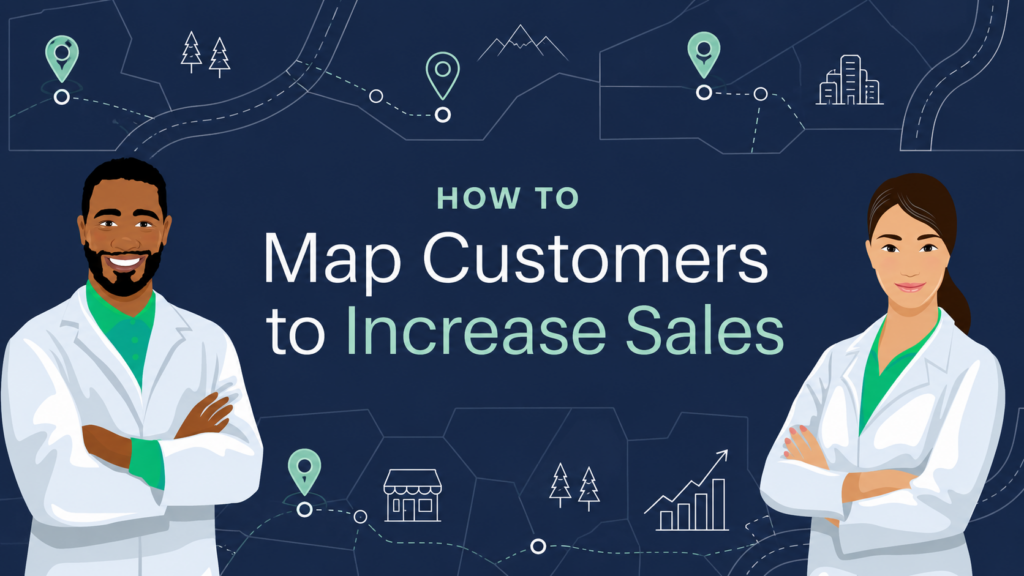
There’s a moment most reps have at some point. You finish a meeting, sit in your car, and think… who else is nearby? There are accounts around you. You just can’t picture them clearly. So, you either drive somewhere familiar or head to your next scheduled stop, even if it’s not the best use of time. That’s usually what kicks off the idea of starting to map customers. Not because it sounds strategic, but because your day starts to feel a little scattered.
And once you notice that feeling, it’s hard to ignore.
It doesn’t happen all at once. Your territory builds over time. A new account gets added here. Another one shifts there. You pick up a few more responsibilities. Suddenly, what used to feel manageable starts to feel… random.
You’re driving farther than you need to. Missing opportunities that were right around the corner. Doubling back without realizing it. It’s not a big, obvious problem. It’s a bunch of small inefficiencies that quietly eat into your day.
And when your schedule is already packed, that adds up fast.
Mapping customers isn’t about having a prettier view of your accounts. It’s about awareness.
When you can see your customers laid out geographically, things start to click in a different way. Clusters are noticed that you previously hadn’t thought about. You realize certain areas are getting too much attention while others are getting ignored.
You start to ask better questions.
Why am I driving across town for this when I have three accounts ten minutes away? Why haven’t I stopped by that area in weeks?
Those questions don’t come up when everything lives in a list, they come up when you can actually see it.
You don’t need to rebuild your entire system to start mapping customers.
Most reps already have the data, it’s just scattered. CRM entries, notes, maybe a few saved locations in your phone. The first step is pulling that into one place where you can view it on a map.
It doesn’t even have to be perfect. Some addresses might be outdated, some accounts might need cleaning up. That’s fine. Even a rough map is better than none.
Because once you see it, you start noticing patterns right away.
One of the first things that stands out when you map customers is clustering.
Accounts tend to group together more than you think. Certain areas become dense without you realizing it. Others look almost empty. That's where opportunity shows up. If you have a cluster of customers in one area, it makes sense to spend more focused time there. Plan a day around it. Stack visits. Build momentum. On the flip side, empty areas raise different questions. Are there missed opportunities? Or is there a reason you haven’t been there?
It’s not always about filling every gap. Sometimes it’s about understanding why the gap exists.
Once your customers are mapped out, your day starts to feel different.
Instead of bouncing between appointments without much thought, you begin to shape your route around what’s nearby. You look ahead and think, if I’m already in this area, who else should I see?
It becomes less about following a rigid schedule and more about making small adjustments in real time. Those adjustments don’t feel like much in the moment. But over a week, they add up. Fewer wasted drives. More conversations. Better use of the time you already have.
A lot of sales happens in the gaps.
You finish a meeting early. Someone cancels. Now, you have thirty minutes you didn’t expect. Without a mapped view of your customers, those moments usually get wasted. So, you grab coffee and sit in your car. You scroll for a bit. With a map, you have options. You can glance at what’s nearby and decide quickly. Maybe it’s a quick drop-in. Maybe it’s just stopping by to stay visible. Either way, it turns unused time into something productive.
Those small decisions compound.
Mapping customers gives you location. But the real value comes when you connect that location to people. Who works at each account? Have you spoken to them recently? Who have you been meaning to follow up with but haven’t?
That’s where things start to feel more intentional. You’re not just visiting places. You’re continuing conversations.
Some reps pair this with a quick LinkedIn check before walking in. Just to see if anything’s changed. It takes a minute, maybe less. But it adds context that a map alone can’t provide.
It’s easy to get caught up in trying to build the perfect territory plan.
The ideal routes. The most efficient coverage. Everything neatly organized. Real life doesn’t cooperate with that. Meetings run long. People cancel. New opportunities pop up in places you didn’t expect. You end up adjusting constantly.
That’s why consistency matters more than perfection. Checking your map before you start your day. Glancing at it between meetings. Logging visits so your data stays accurate.
Small habits, repeated over time. That’s what makes the difference.
You don’t notice it right away. But after a few weeks of mapping customers consistently, your days start to feel different. You start by not guessing as much. Then, you’re not backtracking as often. Next, you’re making quicker decisions about where to go next. Now, your territory starts to feel more familiar. More predictable, even when your schedule isn’t. And that sense of control… it’s subtle, but it matters.
At the end of the day, the job is still about growing relationships and growing sales. Showing up, asking the right questions, and following through. Mapping customers doesn't replace that. It simply gives you a clearer picture of where those conversations can happen and helps you make better use of the time you already have.
Research from Harvard Business Review has also shown that thoughtful territory planning can improve sales performance without increasing headcount, reinforcing the value of planning before you hit the road. No big shift. No dramatic overhaul. Just a series of small adjustments that make your days feel less scattered and a little more intentional.
And over time, that's usually enough to move the needle.
Looking for an easier way to map customers and increase sales? Try RepMove free.